Good Websites For Arabic Music.
And all Free!
(Click on the title for the link).
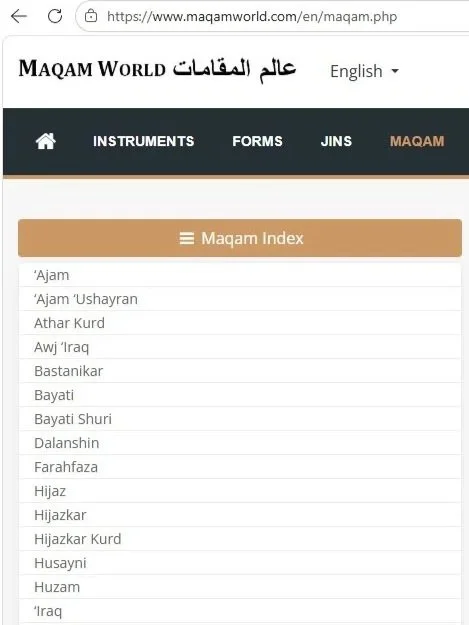
This is probably my favorite online resource for Arabic music.
You’ll find:
A maqam index - summarizing each maqam, with a notated scale and listening examples. Grouping them into families.
There is also a page for the Ajnas, the smaller building blocks of maqamat.
A rhythm index - giving the basic iqa’ patterns and how they are conceptualized with time signatures. Again with listening examples.
A nice description of the different forms of Arabic music.
Some information on the traditional instruments.
You can also find this information and more in Johnny Farraj and Sami Abu Shumays’ book: Inside Arabic Music (2019) Oxford University Press.
The website used to exist before the book, but now it’s an accompaniment.
I think this is a great resource for anyone wanting an overview of many of the basics. I personally find the book’s style to be a bit academic, it’s not a beach read. Though it’s definitely accessible and a nice introduction. I keep returning to the website, however, if there’s a detail like a long iqa’ cycle that I want to check! And I think if you’re just starting out trying to become familiar with the different characters of the maqamat, this is one of the few places you can find nice listening examples you can trust.
2. AMAR Foundation for Arab Music Archiving & Research.
This is one of the most amazing resources for musicians biographies from the 1700s to the 1940s! The interactive timeline is a wonder. Excellently researched, and all translated to English. And a series of Arabic podcasts with English transcriptions. It’s also well worth keeping an eye on their products page - though I didn’t receive a response when enquiring about one of their CDs, I do find it useful to keep an eye out for what might be available elsewhere in online stores.
3. YouTube & Inspired By Arabic Music Playlist
Yes, I know we all know what YouTube is. It’s 100% the best resource for finding recordings of Arabic music. However, I found that when I started out, searches for ‘Arabic music’ often provided a high number of dodgy dance tracks and the like. And as a beginner, it can be hard to know if what you are hearing is actually what it says it is, when it comes to the maqam and style etc. Comments can be misleading too.
To help make YouTube more fun from the start, I’ve made a playlist of 100 musicians from different countries, through different styles and eras. The idea is that it’s a starting place for you to click onto the channels, explore more, and then let the algorithm do its thing. I know I would have liked something like that.
If you are interested in keeping up with the latest Arabic pop releases, the Arab Sounds channel should do the job.
I also recommend a search for the “Katara oud festival”. It’s probably the largest oud festival, showcasing some of the most famous oud players today in beautiful concerts, many of which are available in full on YouTube.
4. Oud Migrations by Rachel Beckles Willson.
For those who are interested in learning more about the history of the instrument, and specific ouds at that. Professor Beckles Willson’s website has a number of blog-style articles that are well-researched on subjects such as ‘the oldest surviving oud?’ and rare ouds.
The Oud: an illustrated history, a book, follows this more easy-going approach, a coffee table style colorful history of some ouds and the oud in general.
5. Neyzen. Classical Notation Archive.
Strictly speaking this is in the Turkish tradition, however, for a long time many Arab countries were within the Ottoman empire and so there are a good deal of pieces like samais and bashrafs that are equally played in Arabic music circles, by Sami al Showa and his group for example. This archive might be fun for more advanced students or researchers to have a dig through, with historical and contemporary pieces listed by maqam.